How a painting filter works
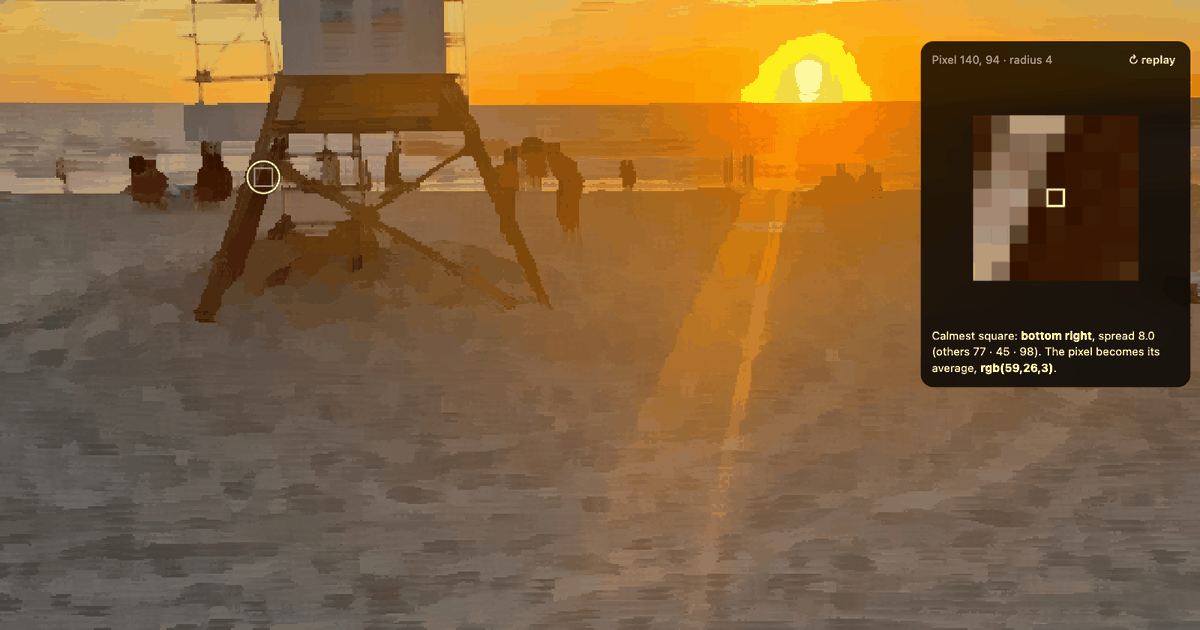
How the Kuwahara filter turns a photo into a painting: compare it with a blur, tap any pixel to watch it choose, and see the eight-sector version run live.
Camera filters, color experiments, and sound-reactive visuals. Why these experiments.
Newest first
Try the Kuwahara explainer without a camera. Live camera use needs your permission. Each demo's How it works explains its controls and limits.
How the Kuwahara filter turns a photo into a painting: compare it with a blur, tap any pixel to watch it choose, and see the eight-sector version run live.
Explore psychedelic-inspired camera art with breathing warps, melting feedback, motion trails, and repeating edges. A visual effect, not a drug simulation.
Turn a camera image into sumi-e-inspired ink washes. Learn how smoothing, tapered edge strokes, dry-brush texture, and simulated paper bleed create the look.
Explore a live pencil sketch filter with directional contours, tone-driven hatching, cross-hatched shadows, colored pencil, and procedural paper texture.
Explore a live watercolor camera filter built from Kuwahara smoothing, soft tone layers, simulated wet edges, pigment variation, and procedural paper.
Study a camera image as two to five gray values. Use squint blur, a lightness split, and a pixel probe to explore notan and painting composition.
Make a live skate-video look with fisheye-style distortion, VHS color smear, scanlines, tape noise, and a date stamp. Learn how the WebGL effects combine.
Create audio-reactive camera visuals with glowing edges, posterized colors, and feedback trails. Learn how frequency bands and onset detection drive the image.
Learn Sobel edge detection with a live camera walkthrough: grayscale, Gaussian blur, horizontal and vertical gradients, edge strength, and thresholding.
Turn a live camera image into a cartoon with Kuwahara smoothing, tone bands, and Sobel outlines. Explore how each stage shapes the cel-shaded look.
Compare color vision deficiency simulation, experimental daltonization, and bold camera outlines. Learn the color transforms and their accessibility limits.
Try a red-cyan anaglyph camera filter and learn how channel separation creates binocular disparity from one image, without reconstructing scene depth.
A mantis shrimp-inspired camera effect with vivid color and animated edge shimmer. Explore its WebGL shaders and why it is not literal animal vision.
Explore a simplified dog color vision filter, with blue-yellow color mapping and illustrative blur and contrast controls. Learn what it cannot simulate.